A meditation asks you to stop, listen, and be still. A mindfulness exercise is different — it fits along with something you are already doing. Washing dishes, walking to the mailbox, waiting for a pot to boil, sitting in a doctor’s waiting room.
These are the practices that tend to stick, because they cost you no extra time. They also happen to be the ones that make the biggest difference to balance, memory, and the small daily frustrations that wear a person down.
Pick one. Do it for a week before you add another. One exercise done daily is worth more than six done once.
1. The Doorway Pause
Choose one doorway in your home — the kitchen, or the bedroom. Every time you walk through it, stop for one breath before you carry on.
That is all. One breath, in and out, standing still in the doorway.
What makes this work is that the doorway does the remembering for you. You are not relying on willpower or a reminder on your telephone. The house itself prompts you, perhaps a dozen times a day, and each pause is a moment when you are fully where you are instead of already in the next room.
2. Washing Your Dishes by Hand
The next time you wash dishes, put your attention entirely into your hands.
Feel the temperature of the water. Notice the weight of the plate changing as it fills and empties. Feel the difference between the smooth back of a spoon and the rough edge of a pan. Listen to the sound the water makes, smell the soap.
Your mind will leave and go to something else. When you notice it has gone, bring it back to your hands.
This one has a quiet gift in it. A chore you have done ten thousand times without noticing becomes something you have actually experienced. People often report that the task takes the same length of time but feels shorter.
3. A Short Walk
On any short walk you already make — to the mailbox, to the car, down the hall — put your attention on the soles of your feet.
Feel each foot make contact with the ground. Heel first, then the ball of the foot, then the toes. Feel your weight shift from one leg to the other. Pay attention to the surface that you are walking on. How does it affect what you feel? Just observe objectively as you take each step.
You do not need to slow down or walk strangely. Walk at your ordinary pace. Just pay close attention to every detail of your walking and make no judgments. Just observe.
There is a plain physical benefit here as well as a mental one. Attention to the feet improves balance, and balance is worth protecting as we get older. This is one of the few mindfulness practices with a direct effect on how steady you are on your feet.
4. The Waiting Room
Waiting is where most of us are least present. We are impatient for the wait to end, so we spend the whole of it somewhere else.
Next time you are waiting — in a doctor’s office, in a queue, on hold on the telephone — try this instead. Let your shoulders drop. Feel your feet on the floor and your back against the seat. Take three slow breaths. Then look around and pay close attention to every detail in the room. Judge nothing. Just observe. Nothing more. It is that simple.
Waiting time is the largest pocket of free practice time most of us have. Doctor’s appointments alone will hand you hours of it in a year.
5. Mindful Eating
At at least one meal a day, eat the first mouthful with your whole attention.
Before you lift the fork, look at the food. Notice the smell, the colors, the way the food is laid out. Then take one mouthful and, before you chew, notice the taste and the texture. Chew slowly. Notice how the taste changes. Judge nothing. Just observe.
Then eat the rest of the meal while periodically doing the same practice.
One mouthful is a small enough promise that you will keep it. And it tends to spread by itself — many people find that within a few days they are eating the first three or four mouthfuls this way without deciding to.
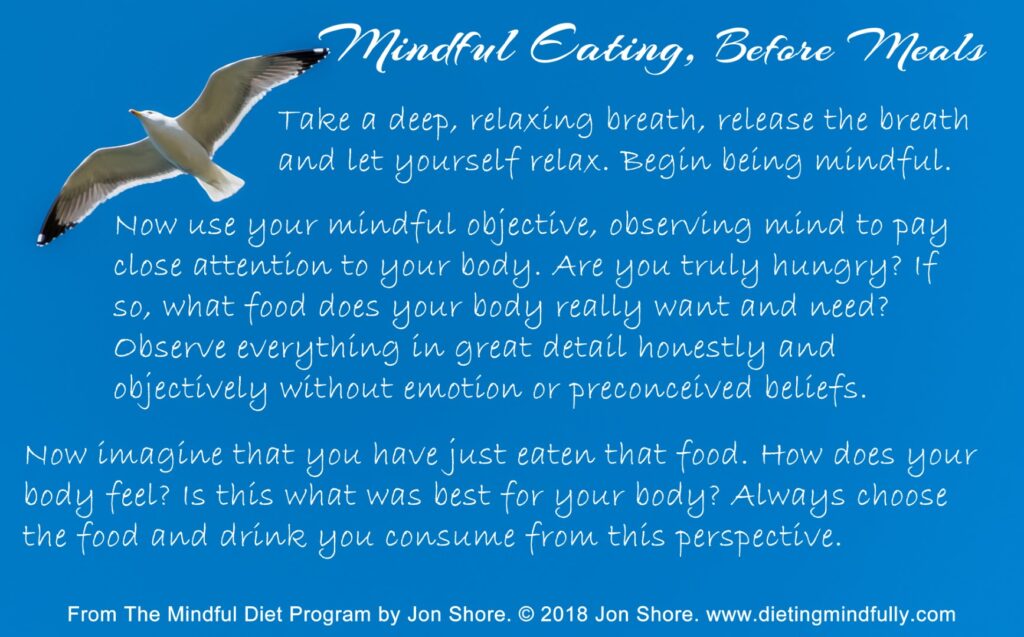
Here is another Mindful Eating practice you can save and do
6. The Telephone Breath
When the telephone rings, let it ring one extra time. Use that ring to take one slow breath before you answer. When you do answer, pay extremely close attention to the process you use to answer the phone. Each motion should feel conscious and deliberate. Be observant. Then pay close attention to how you speak and listen.
It sounds like nothing. But the telephone often brings news, and the difference between answering it braced and answering it settled is not small. One breath is enough to change which of those you are.
Which should I choose?
If you want the one with the broadest effect, take the walking exercise — it helps your balance as well as your mind. If you want the one most likely to become a habit, take the Doorway Pause, because the doorway reminds you without any effort from you.
If you would rather sit down and practice properly, the mindfulness meditations are written out in full and take five minutes. And if you would find it easier to follow a voice, the guided audio recordings talk you through the practice from beginning to end.
Questions are welcome. Write and ask me — I answer every message myself.